
Knowledge Base
Beyond the Roof: Optimising Cold Storage Energy Profiles with Behind-the-Meter Solar
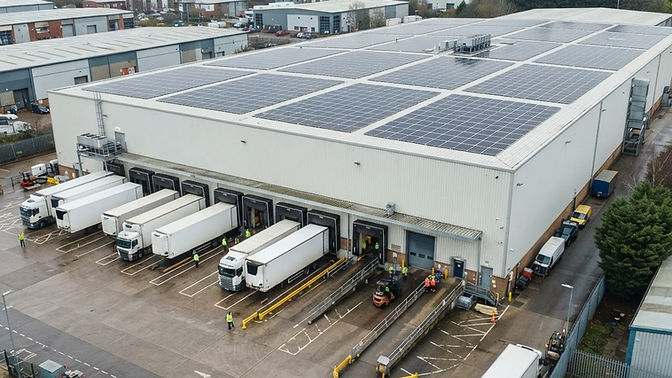
For cold storage operators, refrigeration represents a significant operational cost. This analysis explores how behind-the-meter solar, thermal storage, and battery integration can help manage energy intensity and mitigate grid price volatility.
The Cold Storage Energy Challenge
For operators in food, beverage, and logistics, refrigeration represents a significant operational cost. Research indicates that cold storage facilities consume high levels of energy per square foot, with refrigeration often accounting for over 70% of the total electrical load. This high-demand profile creates a structural vulnerability to volatile grid pricing, but also presents a strategic opportunity for behind-the-meter solar integration.
The Financial Advantage of Onsite Generation
By generating power at the point of use, operators can reduce the volume of electricity purchased at market rates. Onsite behind-the-meter solar can deliver financial value by offsetting energy and delivery charges. Because refrigeration requires a consistent electrical load, businesses are often well-positioned to consume a high proportion of the solar energy generated on-site.
Request a Technical Energy Audit
Load Profile Alignment and Thermal Storage
Integrating Commercial Solar PV allows facilities to align generation with consistent refrigeration baseloads. Beyond direct solar usage, refrigeration assets can act as a form of thermal storage. By adjusting temperature set-points during peak solar generation hours, operators may store energy thermally to reduce compressor activity during non-generation periods. Note that thermal inertia limits must be strictly managed to maintain product safety and quality standards. When further supported by Battery Energy Storage, facilities can mitigate high demand charges by shaving peak electrical loads.
Funding Your Energy Transition
Finance Directors must evaluate the balance between capital expenditure and long-term operational resilience. We offer three primary routes to align energy strategy with corporate goals:
- Fully Funded Solar (PPA): Fix long-term energy rates with no upfront investment, though this typically results in lower lifetime savings than ownership as the investor retains tax benefits.
- Asset Finance: Retain system ownership while spreading costs over fixed terms.
- Outright Purchase: Direct ownership providing the highest potential for long-term operational value.
Explore our Funding overview to compare these models.
Pre-Feasibility Checklist for Site Managers
| Indicator | Requirement | Next Step |
|---|---|---|
| Roof Integrity | Modern structure with load-bearing capacity | Engage a structural engineer for site survey |
| Electricity Usage | Consistent baseload profile | Analyze half-hourly meter data |
| Grid Connection | Available capacity for export | Request G99 grid capacity assessment |
| Energy Procurement | Reliance on time-of-use tariffs | Review current supply contract terms |
Our Commitment to Stewardship
We view commercial solar as a technical infrastructure asset. Whether deploying new systems or providing Operations & Maintenance, the objective is to match the solar generation curve with the specific load profile of your refrigeration assets. To determine the technical viability of your site, contact our team to discuss your requirements. For further insights, visit our Knowledge Base or explore our Project case studies to see how similar sites have managed energy displacement.
Common questions
- How can solar energy benefit cold storage facilities?
- Cold storage facilities have highly predictable, energy-intensive profiles due to constant refrigeration needs. By installing behind-the-meter solar, operators can offset daytime energy demand, which often coincides with peak solar production hours. This directly reduces the grid-imported electricity costs required to maintain low-temperature environments. Integrating solar provides a consistent, lower-cost energy source that helps stabilise operating expenses and improves the overall sustainability credentials of the facility, all while reducing exposure to fluctuating energy market prices.
- What is the role of thermal storage in cold facilities?
- Thermal storage allows cold storage operators to decouple cooling production from immediate energy consumption. By over-cooling the facility or chilled products during times of peak solar generation, the stored 'cold' can be drawn down later when solar output is low. This strategy effectively turns the building itself into a battery, managing energy intensity and reducing the strain on grid connections. When combined with PV and battery storage, thermal management provides a sophisticated way to match onsite supply with constant refrigeration demand.
- Does solar improve resilience in cold storage?
- Solar PV and battery systems can significantly enhance energy resilience for cold storage. By providing an onsite generation source, these systems reduce the total reliance on the grid. In the event of grid instability or supply issues, integrated battery systems can provide critical support for essential cooling infrastructure. This combination ensures that temperature-sensitive stock remains protected for longer periods. For business continuity, a solar-integrated energy strategy provides a robust buffer against both energy price volatility and potential grid disruptions.
Materially updated 17 October 2026
Sources
- SurgePV: Solar ROI for Cold Storage
- Solar Energy UK: Solar Energy
- Research and Markets: Solar-powered Cold Storage Market Report
- Ofgem: Engineering Recommendation G99
- Solar Energy UK: Grid Connection Challenges
- UK Warehousing Association: Grid Connection Reform
- Energy Networks Association: G99 Types B-D Summary
- Yogesh Dahiya: Cold Storage Energy Consumption