
Knowledge Base
Mitigating the 2026 TNUoS Surge: Why Behind-the-Meter Solar is the New Financial Hedge

With TNUoS residual charges set to rise by 64% in 2026, traditional energy efficiency is no longer enough. Discover how behind-the-meter solar and capacity management offer a structural hedge against fixed network costs.
The New Reality of Fixed Network Costs
The UK’s electricity network is undergoing a structural transformation to accommodate the transition to net zero. Central to this is a significant increase in Transmission Network Use of System (TNUoS) charges. As of April 2026, the National Energy System Operator (NESO) has confirmed a 64% increase in TNUoS residual charges [3, 8]. For operations and finance directors, this shift represents a departure from traditional energy management. Because the majority of these charges are now recovered through fixed, daily standing charges rather than usage-based tariffs, they are immune to traditional energy efficiency measures. This necessitates a strategic reassessment of how businesses hedge against non-commodity cost volatility.
The Shift to Fixed Network Recovery
Under the Targeted Charging Review (TCR), TNUoS charges transitioned away from being primarily driven by peak-demand consumption—the historical 'Triad' system—toward a fixed residual charging model. This model assigns sites to specific 'residual charging bands' based on connection voltage and agreed supply capacity. These bands are locked in for the duration of the current price control period, which runs until 2031. Consequently, simply reducing your electricity usage or shifting consumption to off-peak hours will not mitigate these specific costs. The charge is binary: if your site is assigned to a specific band, you pay the associated fixed fee regardless of how much energy you draw from the grid.
Behind-the-Meter Solar as a Financial Hedge
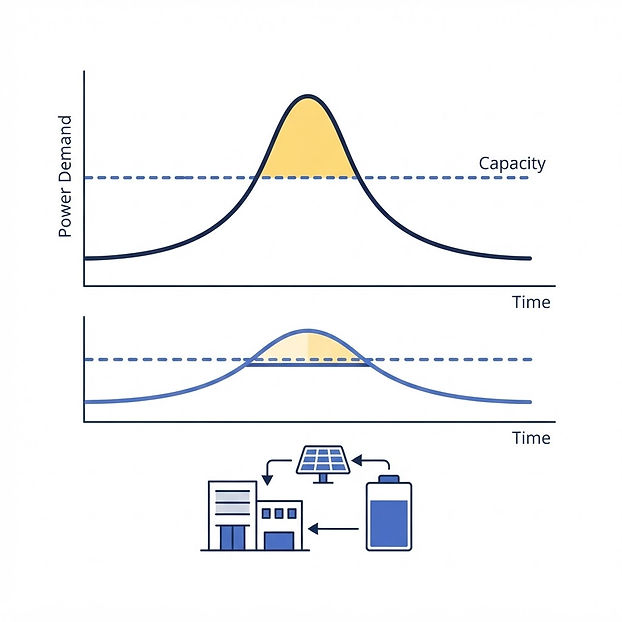
While the 2026 surge is fixed, there is a narrow but significant mechanism for mitigation: altering your site’s charging band by reducing your Maximum Import Capacity (MIC). Many commercial sites carry 'legacy' capacity—agreed limits set years ago that significantly exceed actual peak requirements. By installing Commercial Solar PV paired with Battery Energy Storage, businesses can effectively 'peak shave' their demand. If your on-site generation and storage assets can reliably handle your peak load, you may be able to formally reduce your MIC with your Distribution Network Operator (DNO). If this reduction is sufficient to move your site into a lower residual charging band, you achieve a permanent, structural reduction in your daily standing charges.

Strategic Considerations for Finance Directors
Before pursuing capacity reduction, it is essential to perform a rigorous feasibility study.
- Audit Current Banding: Ensure every meter in your portfolio is assigned to the correct band based on current capacity and voltage.
- Model the Shift: A band change often requires a significant shift in capacity or consumption; in some cases, a reduction of more than 50% is required to trigger a change in band prior to 2031.
- Evaluate Delivery Routes: Depending on your capital allocation strategy, you can access these benefits through Outright Purchase (EPC), Asset Finance, or Fully Funded Solar (PPA).
Key Numbers
| Metric | Impact |
|---|---|
| 64% | Average year-on-year increase in TNUoS residual charges from April 2026 [3, 8]. |
| 90%+ | Proportion of total TNUoS costs now recovered through fixed residual charges. |
| 2031 | Year through which current residual charging bands are locked in under the RIIO-ET3 price control period. |
The 2026 TNUoS surge serves as a clear signal that the financial profile of UK commercial energy is changing. Relying solely on consumption-based savings is no longer sufficient; commercial decision-makers must now look to structural site optimization to hedge against rising non-commodity costs.
Next step
A tailored conversation, not a sales script.
To understand how your specific site banding is impacted by these regulatory shifts, Request a Commercial Solar Proposal.