
Knowledge Base
Business Rates Relief for Solar: A 2026 Update for Property Owners
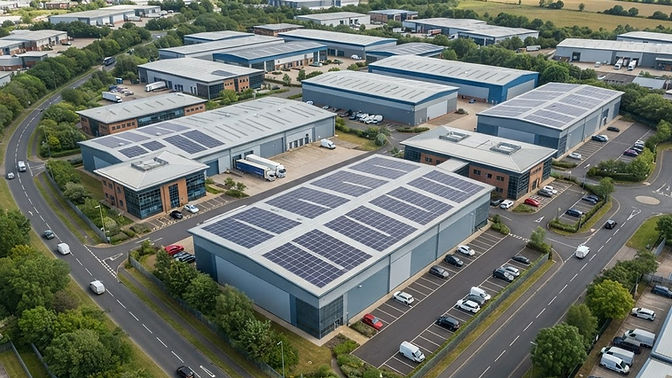
Navigating the intersection of renewable energy investment and property taxation. We clarify the current business rates exemption status for solar PV and what the 2035 policy horizon means for your commercial assets.
The Intersection of Solar Investment and Property Taxation
For commercial property owners and finance directors, the financial case for Commercial Solar PV is built on a combination of energy savings and tax incentives. As of 2026, understanding the interaction between renewable energy infrastructure and business rates is critical for accurate long-term financial modelling. While the primary objective of installing solar is to reduce operational expenditure through self-consumption, the impact on your property’s rateable value remains a key consideration for estates and facilities managers.
The Current Exemption Landscape
In England, the regulatory framework provides a business rates exemption for renewable plant and machinery. This policy is designed to encourage the transition to low-carbon energy by ensuring that the installation of onsite renewable generation does not trigger an increase in a property’s rateable value.
According to HM Treasury, eligible plant and machinery used in onsite renewable energy generation and storage—including rooftop solar panels, wind turbines, and battery storage—are exempt from business rates from 1 April 2022 until 31 March 2035. This ensures that the installation of a system does not result in an immediate increase in your business rates bill.
Implications for Project Planning
The stability of this exemption is a vital component of project bankability. This long-term window of certainty supports those considering Outright Purchase or Asset Finance models, where the business retains ownership of the asset.
For those utilising a Fully Funded Solar (PPA), the tax treatment is often simplified. Because the PPA provider typically retains ownership of the system, the responsibility for the asset—and any associated tax implications—remains with the provider, which may insulate the property owner from the complexities of rating assessments related to the equipment.
Strategic Considerations for Decision-Makers
When evaluating the economic viability of a solar project, consider the following factors:
- Operational Savings: With grid electricity prices remaining significantly higher than 2021 averages, self-consumption of solar energy remains a primary driver for improving the investment case.
- Climate Change Levy (CCL): While self-generated electricity used onsite is not subject to the Climate Change Levy, grid-supplied electricity carries a CCL rate of £0.00801 per kWh as of 1 April 2026. Businesses with a Climate Change Agreement (CCA) may be eligible for a reduced rate of 8% of the main rate.
- Asset Ownership: Whether you choose to own the system or enter a PPA, the business rates exemption on the PV equipment itself helps protect your operating margins.
Key Considerations for Property Owners
| Factor | Impact on Business Rates |
|---|---|
| Solar PV Panels | Exempt in England until 31 March 2035 |
| Inverters & Cabling | Exempt as plant/machinery until 2035 |
| Battery Storage | Exempt as onsite storage until 2035 |
A SolarTech Perspective
At SolarTech UK, we advise our clients to focus on the total cost of ownership and the long-term energy security provided by solar. While tax incentives like business rates exemptions are valuable, they should be viewed as a secondary benefit to the primary goal: reducing your exposure to grid price fluctuations. Whether you are exploring Commercial Solar PV for a manufacturing facility or integrating Battery Energy Storage to maximise self-consumption, our approach is to provide transparent, data-led analysis.
We recommend reviewing your specific property portfolio with your tax adviser to ensure that any planned installations align with your broader estate management strategy. For further guidance, visit our Knowledge Base or Contact our team to discuss your requirements.
Common questions
- Are all commercial solar installations exempt from business rates in England?
- In England, the majority of rooftop solar PV installations are exempt from business rates. This applies to systems primarily used for self-consumption on the property where they are installed. However, specific eligibility criteria apply, and properties used for large-scale energy generation or grid export might be treated differently under local valuation office assessments. It is important to confirm how your specific system configuration interacts with current business rate relief legislation to ensure your asset remains tax-efficient.
- How long will the business rates exemption for solar remain in place?
- Current UK government policy regarding business rates for renewable energy technologies is focused on supporting the transition to net zero. The exemption for solar PV is intended to remain in place to encourage commercial property owners to invest in sustainable energy infrastructure. While policy frameworks can evolve, current legislation maintains this support to help businesses reduce their energy costs and carbon footprint without being penalised through higher property valuations for their energy-efficient upgrades.
- Does adding a battery storage system affect my business rates?
- Generally, integrating battery storage alongside your solar PV system for self-consumption purposes is treated under the same supportive tax framework as the panels themselves. The government’s intent is to incentivise the adoption of integrated renewable energy and storage solutions. By increasing your ability to use the electricity you generate, you avoid the potential complications of business rates being applied to your renewable investment, provided the system is primarily sized for your building's operational requirements.
Materially updated 17 October 2026
Sources
- Commercial Solar UK Trends: What Businesses Should Know in 2026 | EvoEnergy
- Climate Change Levy Exemption and Solar PPAs (UK 2026)
- Commercial Solar in the UK: 2026 Cost, ROI & Best Panel
- Climate Change Levy: changes to rates from 1 April 2026 - GOV.UK
- Written questions and answers - UK Parliament (Business Rates Exemption)
- Commercial Solar Panels UK 2026: Costs, Grants & Tax Relief