
Commercial solar economics
Beyond Solar: Value-Stacking BESS for Industrial Energy Resilience
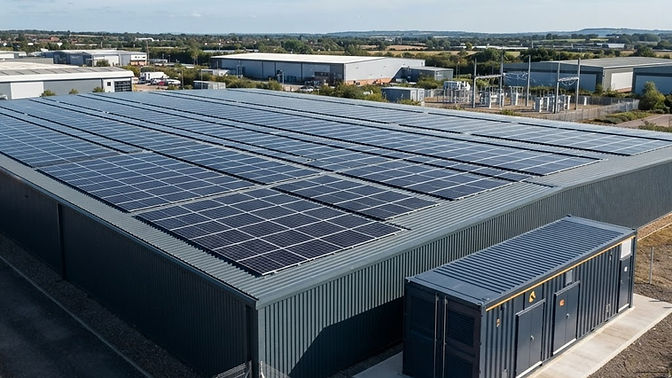
Discover how integrating Battery Energy Storage Systems (BESS) with commercial solar allows businesses to move beyond simple tariff savings into active revenue generation through value-stacking.
The Shift from Passive Generation to Active Energy Management
For many commercial organisations, the initial business case for Commercial Solar PV was straightforward: generate clean electricity, reduce grid reliance, and lower operational expenditure. However, as the UK energy landscape evolves, the limitations of solar-only systems—specifically the mismatch between peak generation and peak consumption—have become a focal point for finance and operations directors.
Behind-the-meter Battery Energy Storage adoption has reached a critical inflection point. With system costs falling by over 50% in the last two years [1], the economic viability of hybrid models has shifted from a 'nice-to-have' to a core component of industrial energy strategy. The opportunity now lies in 'value-stacking': using a single battery asset to capture multiple, simultaneous revenue streams.
Understanding the Value Stack
Value-stacking is the practice of deploying a single BESS asset to perform multiple functions, each generating distinct financial returns. For an industrial site, these typically fall into three categories:
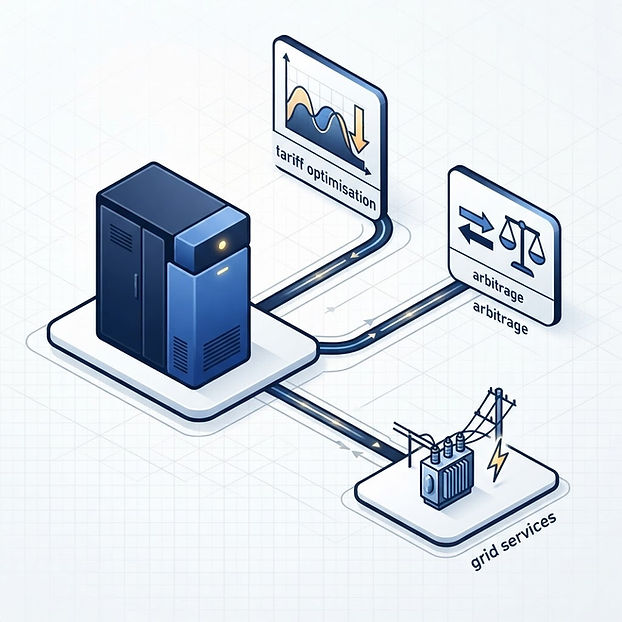
1. Tariff Optimisation and Self-Consumption
This remains the foundation of the business case. By capturing excess solar generation that would otherwise be exported at lower rates, businesses can shift energy use to peak tariff windows [4]. For sites with high peak demand charges, a BESS can shave 80-150kW off peak loads, potentially saving £8,000-£25,000 annually on capacity charges alone [4].
2. Dynamic Arbitrage
By charging during low-tariff periods and discharging during high-price windows, businesses can exploit the volatility of the wholesale market [3]. With dynamic tariffs, the daily price spread can be significant, turning the battery into a profit centre rather than just a cost-mitigation tool [4].
3. Grid Services and Flexibility
This is where the most significant 'upside' is found. Through aggregators, commercial sites can participate in National Grid ESO services—such as the Balancing Mechanism or frequency response—and local DNO flexibility tenders [4], [6]. These services pay for the availability of the asset to support grid stability, providing a revenue stream that is often independent of the site’s own energy consumption [7], [10].

Financial Comparison: Solar-Only vs. Hybrid BESS
| Feature | Solar-Only | Solar + BESS (Hybrid) |
|---|---|---|
| Primary Value | Tariff savings | Tariff savings + Arbitrage + Grid Revenue |
| Complexity | Low | Moderate to High |
| Revenue Streams | Single (Avoided cost) | Multiple (Stacked) |
| Grid Interaction | Passive | Active (Flexibility provider) |
Strategic Implications for Decision-Makers
For Finance Directors, the primary appeal of a hybrid model is the diversification of energy risk. While solar provides a hedge against rising energy costs, BESS provides a hedge against market volatility and grid constraints.
For Operations and Estates Managers, the resilience benefits are equally compelling. Beyond the financial returns, BESS can provide critical protection against brief grid dropouts, ensuring that sensitive processes—such as those in cold storage or data centres—remain operational [3], [8].
A Grounded Perspective on Implementation
Integrating BESS is not a one-size-fits-all solution. The economic case is strongest for businesses with 24/7 process operations, high evening peaks, or those facing significant grid connection constraints [4].
Whether you choose Fully Funded Solar (PPA) to remove upfront capital requirements or Outright Purchase (EPC) to maximise long-term operational value, the integration of storage should be modelled against your specific half-hourly consumption data. We advise businesses to look beyond the initial hardware costs and focus on the 'total value of ownership' over the system's 15+ year lifespan, accounting for both energy savings and potential grid service revenues [4], [10].
As you evaluate your energy strategy, consider whether your current infrastructure is prepared for the next decade of grid participation. Our team is available to model the potential value-stacking opportunities for your specific site profile.
Common questions
- What does it mean to 'value-stack' with a Battery Energy Storage System?
- Value-stacking refers to using a single battery energy storage system to provide multiple revenue or cost-saving streams simultaneously. Instead of only using a battery to store solar energy for later use, you can utilize the stored capacity to engage in grid services, provide peak shaving to reduce demand charges, and improve industrial power quality. By layering these capabilities, a business can optimize the financial return of the asset while simultaneously increasing operational resilience and reducing the total carbon footprint of the facility.
- How does BESS improve energy resilience for industrial sites?
- Battery Energy Storage Systems enhance industrial energy resilience by acting as a buffer against grid instability and peak demand volatility. When integrated with commercial solar, the battery can maintain critical loads during short-term grid outages or power quality fluctuations. For industrial operations that are sensitive to downtime, this reliability is essential. By smoothing out supply and controlling the timing of energy draw from the grid, businesses can protect their equipment and maintain consistent output, regardless of broader grid conditions.
- Is a battery system necessary for all commercial solar projects?
- While commercial solar can be effective on its own, a battery system is increasingly important for businesses aiming for higher self-consumption rates and enhanced grid independence. If your peak energy demand does not align with your solar generation window, or if you need to participate in flexible energy market services, a battery is a critical component. A battery provides the flexibility to decouple generation from consumption, allowing you to optimize your energy strategy according to current market signals and your facility's operational requirements.
Sources
- BNEF and Economics for a UK supermarket
- Commercial & Industrial Battery Storage: A Guide for UK Businesses
- The economics of behind-the-meter battery storage. Part 1: Reducing your energy bill
- Battery Storage on Commercial Solar 2026 | When It Pays Back
- Briefing Paper on Behind-the-Meter and Co-Located Battery Energy Storage Systems (BESS)
- Flexibility - UKPN DSO
- Investing in battery energy storage systems (BESS)
- A guide to solar PV for the Food and Drink Manufacturers
- Synertics - Revenue Stacking in Co-Located BESS
- Commercial Battery Storage UK: How Businesses Store and Use Solar