
Commercial solar economics
Mitigating Export Curtailment Risks in Commercial Solar Projects

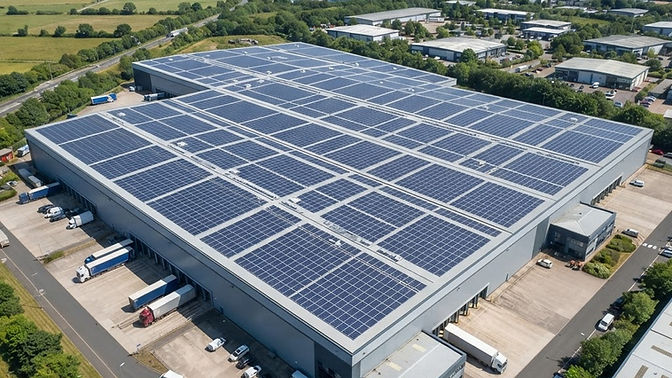
Understand how DNO export constraints impact your solar ROI and learn how to navigate G100 compliance and battery integration to protect your project's viability.
The Challenge of Grid Constraints
For many commercial organisations, the ambition to deploy large-scale solar PV is increasingly met with a technical hurdle: the Distribution Network Operator (DNO) export limit. When a site’s generation capacity exceeds the local grid's ability to accept power, the DNO may impose a cap on the amount of electricity that can be exported to the network [8]. For finance and operations directors, this creates a clear risk—if your system is forced to curtail generation during peak production hours, the projected return on investment (ROI) can be significantly eroded.
It is critical to distinguish between generation capacity and export capacity [4]. You may be permitted to install a large solar array to meet your internal demand, but the DNO may restrict the amount of surplus energy that can flow back into the grid [4]. Understanding this distinction early in the project lifecycle is essential for maintaining financial modelling accuracy.
Navigating G99 and G100 Compliance
In the UK, connecting generation assets requires adherence to strict technical standards. Installations above 16A per phase typically fall under the G99 application process [9, 10]. If your site faces export constraints, you will likely need to implement an Export Limitation Scheme (ELS) that complies with EREC G100 standards [4, 6].
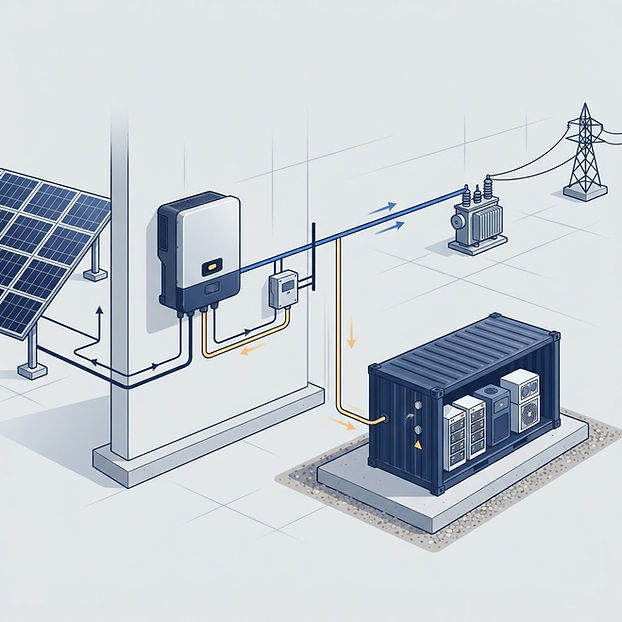
An ELS acts as a gatekeeper, monitoring the net flow at your supply intake [6]. If the system detects that export is approaching the DNO-mandated limit, the controller will automatically throttle the inverter output or divert energy to prevent a breach [4, 6]. While this ensures compliance and avoids costly grid reinforcement charges, it effectively turns off potential revenue or savings if not managed correctly.
Strategic Mitigation: The Role of Battery Storage
Rather than accepting curtailment as an unavoidable loss, many businesses are choosing to co-locate Battery Energy Storage with their Commercial Solar PV systems [2, 8].
By integrating a battery, you can capture the excess energy that would otherwise be curtailed by the G100 controller [8]. This stored energy can then be discharged during periods of high site demand or peak tariff pricing, effectively shifting your generation profile to match your consumption [2]. This strategy transforms a potential 'lost' unit of electricity into a valuable asset that reduces your reliance on grid-imported power.
Comparison of Mitigation Strategies
| Strategy | Mechanism | Primary Benefit |
|---|---|---|
| Export Limitation (G100) | Throttles inverter output | Ensures DNO compliance; avoids grid upgrade costs |
| Battery Co-location | Stores excess energy for later use | Maximises self-consumption; mitigates curtailment losses |
| Grid Reinforcement | Upgrades local network capacity | Removes export caps; requires DNO approval and capital |

Commercial Implications for Decision-Makers
For Finance Directors, the primary concern is the 'cost of inaction' versus the 'cost of mitigation.' Delaying a project to wait for grid upgrades can result in missed savings and exposure to volatile energy markets. Conversely, installing a system that is heavily curtailed without a storage strategy may fail to meet internal hurdle rates.
Operations and Estates Managers should prioritise early-stage grid feasibility studies. Understanding your site's specific export limit before finalising the system design allows for a more robust Funding overview strategy. Whether you choose Fully Funded Solar (PPA) or Outright Purchase, the technical design must account for the reality of your local grid connection.
The SolarTech Perspective
At SolarTech, we believe that grid constraints should not be a barrier to decarbonisation. Our approach focuses on transparent, data-led design. We work with our clients to model the impact of export limits on their specific load profiles, ensuring that the proposed system size and storage capacity are optimised for the site's unique constraints. We do not promise outcomes that the grid cannot support; instead, we provide the technical rigour required to make informed investment decisions.
For ongoing performance, our Operations & Maintenance teams ensure that your G100 controllers and inverters remain calibrated and compliant, protecting your asset's long-term operational value.
Sources
- SolarTech - Industries: Schools & Education
- SolarTech UK - Commercial Solar
- SolarTech - Industries: Data Centres
- National Grid - Export Limitation
- SolarTech - Funding
- ENICO - G100 Export & Import Limitation
- SSEN - G99 Fast Track Process
- Business Energy Deals - Export Limitation
- 1app.energy - G98, G99 and G100 Guide
- Sunsave - G99 Application Guide
Next step
A tailored conversation, not a sales script.
If you are concerned about grid constraints impacting your solar project, our team can provide a technical feasibility assessment to help you navigate DNO requirements and optimise your system design.