
Energy market intelligence
Navigating Non-Commodity Costs: Why Solar is the Hedge Against Rising Network Charges
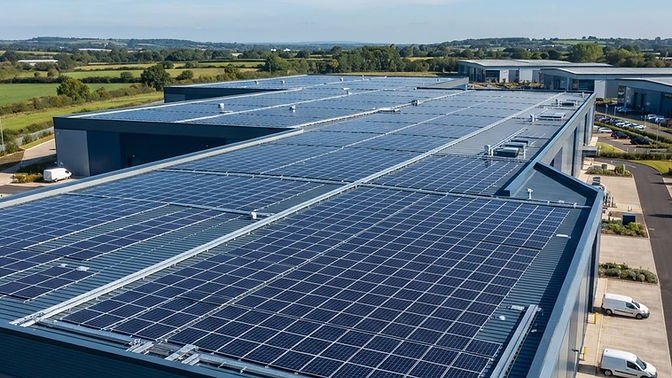
While wholesale energy prices have stabilized, commercial electricity bills continue to climb. Discover how behind-the-meter solar mitigates the impact of rising non-commodity network charges.
The Hidden Inflation in Your Energy Bill
For many finance and operations directors, the recent stabilization of wholesale energy prices has provided a sense of relief. However, a closer inspection of monthly invoices reveals a persistent upward trend in total expenditure. The culprit is not the energy itself, but the 'non-commodity' costs—the complex web of network charges, policy levies, and system fees that now account for a significant portion of the average commercial electricity bill [3].
As these charges continue to rise, they are effectively decoupling from wholesale market trends, creating a 'floor' for energy costs that businesses cannot escape through traditional procurement strategies alone. For energy-intensive sectors, this represents a structural risk that requires a shift in strategy: moving from passive consumption to active, behind-the-meter generation.
Understanding the Non-Commodity Burden
Non-commodity costs are the mandatory fees required to maintain, operate, and upgrade the UK’s electricity infrastructure [3]. These include:
- DUoS (Distribution Use of System): Charges for the local network that carries power to your site [4].
- TNUoS (Transmission Network Use of System): Fees for the high-voltage national transmission network [3].
- Policy Levies: Costs associated with government schemes, such as the Renewables Obligation (RO) and Feed-in Tariffs (FiT) [2], [3].
While wholesale prices fluctuate, these network charges are often fixed or rising to fund grid modernization [4]. Crucially, when you consume electricity from the grid, you pay these charges on every kilowatt-hour (kWh) used. When you generate electricity behind-the-meter via Commercial Solar PV, you bypass the grid for that portion of your demand, effectively avoiding the associated network and policy levies [2].
The Strategic Hedge
By generating power on-site, businesses transform their energy profile from a purely variable cost to a hybrid model. This provides a natural hedge against the volatility of non-commodity cost increases.
Key Financial Impacts
| Cost Component | Impact of Behind-the-Meter Solar |
|---|---|
| Wholesale Energy | Replaced by lower-cost solar generation |
| Network Charges (DUoS/TNUoS) | Avoided for all self-consumed solar energy |
| Policy Levies | Avoided for behind-the-meter generation [2] |
For a mid-sized factory or logistics hub, the cumulative impact of these avoided costs can be substantial. While a standard procurement contract passes these 'pass-through' costs directly to the end-user, an on-site solar installation locks in a predictable cost of generation for the life of the asset [9].
Implementation Pathways
Mitigating these costs does not always require significant capital expenditure. SolarTech UK provides three distinct Funding routes to align with your financial objectives:
- Fully Funded Solar (PPA): Ideal for businesses looking to hedge against rising costs without upfront investment. You purchase the solar electricity at a long-term, agreed tariff, bypassing grid-based network charges.
- Asset Finance: Allows you to own the system and capture the full long-term operational value, with finance terms of up to 10 years.
- Outright Purchase: Provides direct ownership, maximizing long-term ROI and providing the greatest protection against future non-commodity cost inflation.
Integrating Storage for Maximum Impact
To further insulate your business, Battery Energy Storage can be integrated with your solar array. This allows you to store excess generation for use during peak tariff periods or to manage site demand, further reducing reliance on the grid when network charges are at their highest [1].
A Disciplined Approach to Energy Management
For finance directors and estates managers, the objective is clear: reduce exposure to uncontrollable grid costs. By auditing your current bill to separate commodity from non-commodity charges, you can accurately model the savings potential of an on-site system [2].
We recommend starting with a site-specific feasibility assessment. This ensures that any proposed solution is engineered around your actual consumption patterns and tariff structure, rather than generic savings projections. For ongoing performance, professional Operations & Maintenance ensures that your system continues to deliver the expected hedge against rising energy costs for decades to come.
Sources
Next step
A tailored conversation, not a sales script.
Ready to mitigate your exposure to rising network charges? Request a tailored commercial solar proposal to see how much your business could save.